
Cincinnati and Northern Kentucky are moving through another wave of growth in 2026. In this Team Sztanyo Live, Eric broke down the biggest local development stories shaping the region right now: the next phase of The Banks, industrial expansion in Fairfield, new 55+ housing in Oakley, the Hyde Park Square density debate, Covington’s possible permanent farmers market site, Brent Spence Bridge construction, affordable senior housing in Walnut Hills, mixed-use growth in Independence, and a fun NKU/TANK public art project for BLINK.
The details are different from neighborhood to neighborhood, but the bigger story is the same: Cincinnati is trying to grow while preserving the character, affordability, and community feel that make people want to live here in the first place.
Watch the full Cincinnati and NKY growth update
If you want the full conversation, watch the June 11 Team Sztanyo Live here:
The Banks: Cincinnati is looking for a development quarterback
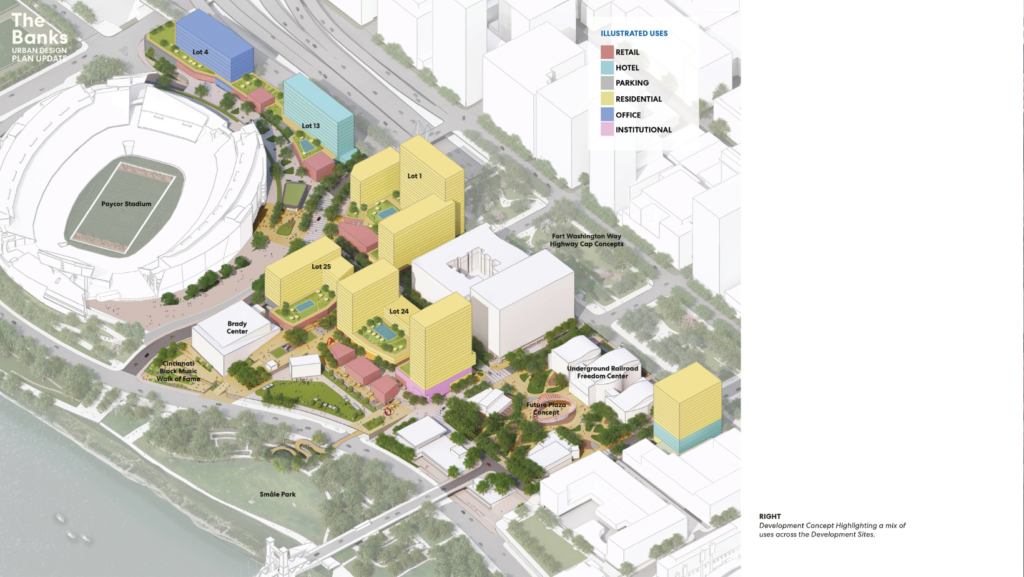
The headline story is still The Banks. Cincinnati and Hamilton County are exploring a master developer approach for the remaining riverfront parcels, and the vision discussed in the live stream includes a major mix of housing, neighborhood-serving retail, office, hotel space, and possible residential towers.
Eric’s key point from the transcript was that The Banks already works as a destination. People go there for Reds games, Bengals games, restaurants, concerts, Smale Riverfront Park, and events along the river. The next question is whether it can become a more complete daily-life neighborhood.
That is why the phrase master developer matters. A coordinated lead developer could help the remaining blocks feel like one connected district instead of separate projects stitched together over time. That kind of coordination matters because riverfront development is complicated: infrastructure, parking podiums, floodplain realities, public space, and financing all have to work together.
For more background on the riverfront district itself, the official The Banks Cincinnati site is a helpful starting point. We also covered the first round of this discussion in our recent post on Cincinnati’s $800M riverfront bet.
Fairfield’s industrial park shows the strength of Cincinnati’s economy
The live also moved north to Fairfield, where a 1.29 million-square-foot industrial park is planned on roughly 140 acres. On the surface, that sounds like a commercial real estate story. But for homeowners and relocation buyers, it says something bigger about the region.
Cincinnati’s economy is not built around one single industry. That diversity is one of the reasons the metro has remained relatively stable compared with cities that rise or fall on one dominant employer or sector. Industrial growth can bring jobs, tax base, logistics activity, manufacturing support, and long-term confidence from investors.
Of course, growth also creates tradeoffs. Industrial projects can raise concerns about traffic, land use, farmland, stormwater, floodplain constraints, and infrastructure. That is why stories like this are not simply “good” or “bad.” They are signals that a region is growing, and local communities have to decide how to balance jobs with daily quality of life.
Oakley is adding a new 55+ active-adult housing option
Oakley continues to be one of Cincinnati’s most active neighborhoods, and the proposed 55+ active-adult community at Three Oaks is another example. The project discussed in the live stream is not traditional assisted living. It is aimed at active adults who want lower-maintenance living with amenities, walkability, and access to restaurants, groceries, retail, and daily conveniences.
That matters because Greater Cincinnati needs more housing choices for empty nesters and downsizers. Many people want to stay close to the neighborhoods they love without maintaining a larger single-family home forever. When the region creates more appealing downsizing options, it can also help free up existing housing stock for younger buyers and families.
Oakley is a natural fit because it already has a strong mix of retail, restaurants, housing, and connectivity. For buyers comparing neighborhoods by price and lifestyle, our guide to Cincinnati suburbs by budget is a useful companion read.
Hyde Park Square is the density-versus-character debate in one place
The Hyde Park Square redevelopment conversation may be one of the most important neighborhood stories in the city because it captures a Cincinnati-wide question: how do you add needed housing without flattening the character that makes people love a neighborhood?
The revised plan discussed in the live stream includes new apartments, renovated apartments, retail, plazas, and underground parking. It also brought continued pushback from neighbors concerned about the scale of the project and the possible demolition of the Peebles building.
Eric’s take was balanced: Cincinnati needs more housing, especially in high-demand neighborhoods, but the city also needs to be thoughtful about architecture, history, and neighborhood identity. Hyde Park is desirable because of its walkability, prestige, square, homes, and character. If growth erases the things people came for, the city loses something real.
This is not just a Hyde Park question. It applies in Pleasant Ridge, East Walnut Hills, Over-the-Rhine, Fort Thomas, Covington, and other neighborhoods where growth and preservation are both legitimate priorities. If you are relocating and trying to understand these local tradeoffs, start with 13 things to know before moving to Cincinnati.
Covington’s Pike Street market idea could become a community anchor
Compared with The Banks, Covington’s possible permanent farmers market site on Pike Street is smaller in acreage. But small civic projects can have an outsized impact on how a neighborhood feels.
The live stream highlighted the possibility of turning a Pike Street property into a long-term home for the Covington Farmers Market. That kind of project can support local food, small businesses, walkability, neighborhood identity, and the kind of everyday gathering place that makes a city feel alive.
If you are considering Northern Kentucky, Covington is one of the most interesting communities in the metro because it contains several distinct lifestyles in one city: riverfront living, MainStrasse, historic streets, more suburban-feeling pockets, and quick downtown Cincinnati access. Our post on a Covington riverfront condo gives a good feel for one version of that lifestyle.
Brent Spence Bridge construction is now a daily-life issue
The Brent Spence Bridge Corridor Project has moved from a future infrastructure story to something commuters and local businesses have to deal with now. The project is huge for Cincinnati and Northern Kentucky, but construction fatigue is going to be real.
Eric emphasized that better infrastructure can support long-term growth, but the short-term effect is changed routes, ramp closures, traffic headaches, and the need to stay intentional about visiting downtown Cincinnati and Covington businesses. If people start avoiding those areas because access feels too complicated, local businesses can feel it.
For official updates, detours, and project context, check the Brent Spence Bridge Corridor Project site.
Walnut Hills shows why preserving affordable housing matters
New construction gets a lot of attention, but preserving existing affordable housing can be just as important. In Walnut Hills, the live stream covered the renovation of a historic building that preserved affordable senior housing.
That matters for two reasons. First, Cincinnati needs housing supply across price points, not just luxury apartments or new single-family homes. Second, older buildings can be assets when the financing works and the right partners are involved. Preservation can keep residents in place, protect affordability, and maintain neighborhood character.
This connects back to the Oakley active-adult story. The region is aging, and housing needs are changing. We need active-adult apartments, senior affordable housing, multigenerational options, and more low-maintenance homes that let people stay connected to the communities they love.
Independence is part of NKY’s next suburban growth wave
Northern Kentucky growth is not limited to the riverfront. Independence is seeing serious development pressure too, including apartments, business space, and corridor growth near Kentucky 17.
The larger takeaway is that suburban growth is changing. It is not only single-family subdivisions anymore. More suburban projects are adding apartments, retail, and mixed-use elements. Buyers increasingly want access to groceries, restaurants, gyms, trails, and everyday amenities without having to drive 20 minutes for everything.
Independence, Alexandria, Union, Hebron, Walton, and other NKY communities are all part of that broader conversation. For some buyers, that growth is exciting. For others, traffic and infrastructure are the concern. Both reactions make sense.
BLINK, NKU, TANK, and why culture belongs in the real estate conversation
The live wrapped with a lighter story: Northern Kentucky University students designing a public art installation on a TANK bus for BLINK. It is a fun local story, but it also points to something bigger.
People do not choose a place to live based only on price, commute, and bedroom count. They choose a community for energy, roots, culture, identity, events, and the life they can imagine building there. That is why public art, bridges, festivals, parks, sports, schools, restaurants, and local pride all belong in the real estate conversation.
If you are new to the region, BLINK is one of Cincinnati and Northern Kentucky’s signature public art events, and TANK is the transit system serving Northern Kentucky and downtown Cincinnati.
What this means if you are moving to Cincinnati or Northern Kentucky
The big lesson from this live stream is that Cincinnati’s growth is not happening in one place or one category. It is riverfront housing, industrial development, senior living, historic preservation, suburban mixed-use projects, infrastructure, public art, and neighborhood identity all at once.
That can be exciting, but it also makes local guidance more important. A buyer looking at Hyde Park is asking a different question than a buyer looking at Independence. A seller near Covington needs a different marketing story than a seller in Oakley. A relocation family may care about schools, commute, parks, walkability, grandparents moving nearby, or whether a neighborhood feels like a place to put down roots.
That is where Team Sztanyo can help. If you are early in the process, read our guide to moving to Cincinnati or download the free Cincinnati relocation guide. If you are ready to talk through your move, contact Team Sztanyo.
FAQ: Cincinnati and NKY growth in 2026
Is Cincinnati still a good place to move in 2026?
Yes, especially for people who value affordability, family roots, job access, parks, sports, architecture, and neighborhood variety. The right fit depends on your budget, commute, lifestyle, and school needs.
Will The Banks become more residential?
That is the direction city and county leaders appear to be exploring. The major question is whether a master developer can coordinate the remaining parcels, financing, infrastructure, parking, and public-space needs.
Is Northern Kentucky still growing?
Yes. Covington, Independence, Alexandria, Union, Hebron, Walton, and other NKY communities are seeing different kinds of growth, from riverfront redevelopment to suburban mixed-use and new construction.
Should buyers worry about Brent Spence construction?
Buyers should understand the commute impacts, but the project is also a major long-term infrastructure investment. If you commute across the river, route planning matters more than usual during construction.
Team Sztanyo
Find your home. Strengthen your family.